U.S. flag

An official website of the United States government

NEWS ARCHIVE

Browse news articles

Published Date Between
Search Results(180)
Published on

The 2017 Northern Plains drought sparked wildfires, destroyed livestock, and reduced agricultural production. Neither the drought’s swift onset nor its severity were forecasted. In May 2017, the region was mostly drought-free, and at least average summer precipitation was forecasted. By July 2017, North Dakota, South Dakota, eastern Montana, and the Canadian prairies were experiencing severe to extreme drought, resulting in fires that burned 4.8 million acres across both countries and U.S. agricultural losses in excess of $2.6 billion dollars. NIDIS and partners have published two reports to examine the evolution and impacts of the drought, as well as lessons learned, needs, and gaps.

Published on

NIDIS and the University of Colorado-Boulder Masters of the Environment Program are teaming up on two drought-related research projects. One project team will examine drought vulnerability and information needs for the outdoor recreation industry. The other project team will develop a NIDIS tribal engagement strategy and other tools to ensure tribal communities have the drought data and resources they need. Both projects will be completed by the end of 2019. 

Published on

California and Nevada’s climate and weather patterns create fire-prone environments for many wildland–urban interface communities, highlighting the value in understanding the relationships between drought and wildfire. More specifically, information is needed on how drought indices are related to fire danger outputs that are commonly used in fire management.

Published on

In 2011, Texas experienced severe agricultural loss, wildfires, and widespread tree mortality in its worst drought since 2000. According to the US Drought Monitor, more than 80% of Texas land area experienced exceptional drought conditions from the spring of 2011 to the beginning of 2012. While these tools are useful for looking at drought conditions at the state level, measuring the local impacts of drought, such as tree mortality, is often challenging. To investigate if satellite data can be used to provide estimates on how urban trees respond to widespread drought, academic and federal researchers partnered with the NASA DEVELOP program.

Published on

In an era of increasing wealth of earth observations, approaches for quickly accessing, analyzing, and visualizing environmental data to better inform decision making at relevant scales is needed. Climate Engine enables users to utilize on-demand cloud computing and visualization to analyze and interact with climate and earth observations for decision support related to drought, water use, agriculture, wildfire, and ecology.

Published on

Drought can have a significant impact on the management and operations of water utilities, from loss of water supply and poor source water quality to increased demand from customers and reduced revenues. Changing conditions in precipitation, snowpack, soil moisture, temperature, and evapotranspiration must be well monitored and better forecasted to provide water managers early warning of drought. Water managers facing water shortages need access to new technologies, tools, and resources to better understand and reduce drought risk to their water supply systems.

Published on

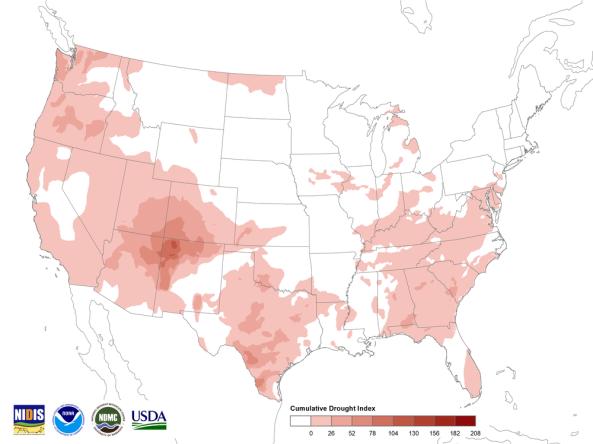
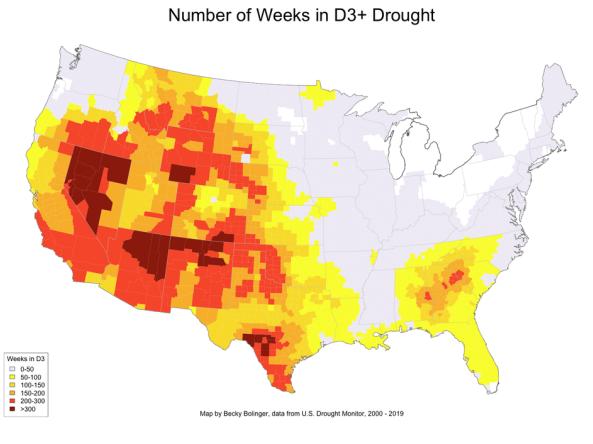
Drought is a normal part of our climate cycle. Often underestimated due to its slow onset, drought stands as the second most costly hazard in the United States. According to the U.S. Billion-Dollar Weather and Climate Disasters, generated at NOAA’s National Centers for Environmental Information (NCEI), 26 drought events between 1980 and 2018 caused specific losses over $1.0 Billion, resulting in $244.3 Billion in direct damages from those events alone. This does not include numerous drought events with losses under $1 Billion as well as indirect impact of drought to the economy. Second only to tropical cyclones, drought affects agriculture, water supply, energy, wildlife, public health, and has many other economic, environmental, and social impacts.

Published on

Elizabeth Weight, CIRES/NIDIS Regional Drought Information Systems Coordinator, represented NIDIS and CIRES in the May 2018 workshop “Advancing Sustainability of U.S.-Mexico Transboundary Drylands.” Ms. Weight’s contribution to the workshop, synthesized in the proceedings, focused on drought early warning systems as a potential innovative bi-national research collaboration and management solution for U.S.-Mexico transboundary drylands areas.

Published on

The Colorado Water Conservation Board (CWCB), part of the state’s Department of Natural Resources, has launched an interactive dashboard that displays drought vulnerability at the state and county level based on Colorado’s 2018 Drought Plan. An Esri Story Map, the platform takes users through visual summaries of Colorado drought risk by sectors, using images and graphs to provide an interactive and engaging experience.

Published on

The Colorado River provides water to almost 40 million people and 4 million acres of farmland. Since 2000, historically dry conditions have added stress to the Colorado River’s water resources. As a result, the risk of reaching critically low elevations at Lakes Powell and Mead has increased nearly four-fold over the past decade. Critically low reservoir levels could affect compliance with the 1922 Colorado River Compact; Lake Powell could drop below the level required to generate hydropower; and the economies, livelihoods, and natural resources of the Basin states could be negatively impacted.